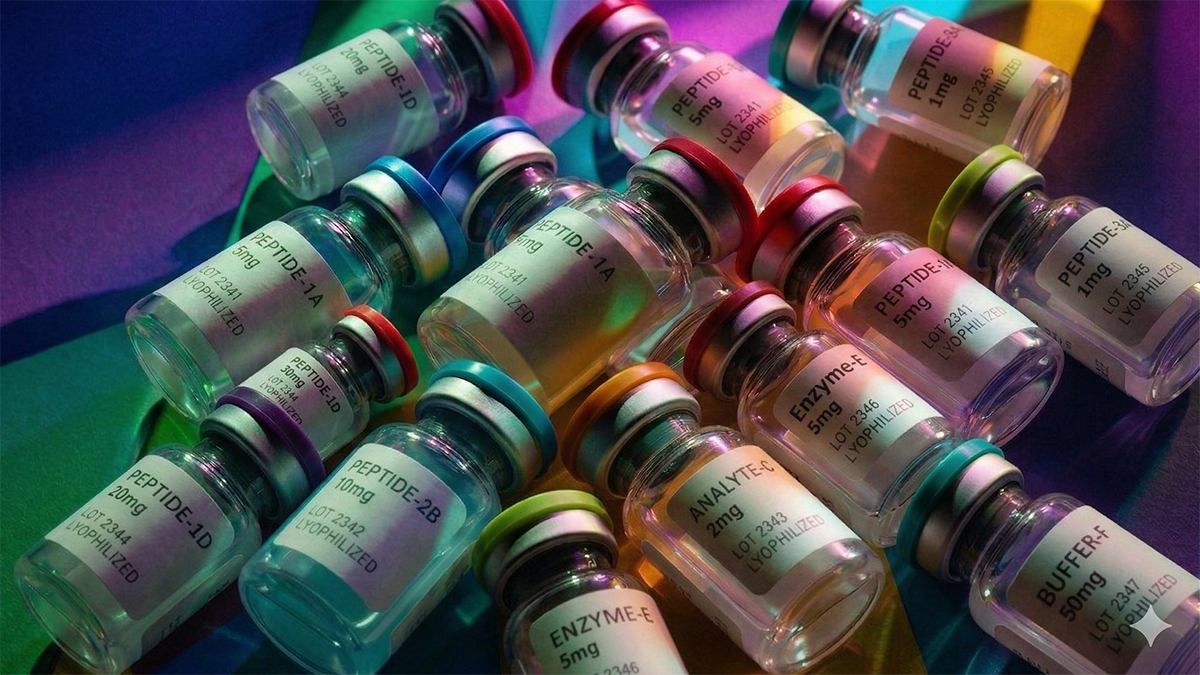
In the modern landscape of wellness, a quiet revolution is taking place. It’s referred to as Sovereign Health. At the heart of this trend is the exploding “gray market’ of research peptides, a class of compounds once reserved for clinical laboratories that are now being self-administered by millions for weight loss, anti-aging, and physical regeneration. This includes the explosion of telehealth services offering GLP-1s for weight loss with Semaglutide and Tirzepatide—compounded generics for Ozempic/Wegovy and Mounjaro/Zepbound.
What Are Peptides?
Our bodies make peptides naturally. Peptides are short chains of amino acids (typically 2–50) that act as signaling molecules in the body. If hormones are the body’s “hardware,” peptides are the “software” that tells cells how to behave. Since they occur naturally in the body, peptides offer a high safety profile for pursuing highly desirable benefits in three main categories:
1. Weight Loss and Metabolic Control The most famous examples are GLP-1 agonists—Semaglutide and Tirzepatide. While these are FDA-approved as medications (Wegovy, Zepbound), the high cost and strict prescription requirements have driven many to purchase “research-grade” versions like those on this website.
- Mechanism: These peptides mimic natural hormones that regulate insulin and signal satiety to the brain.
- New Frontiers: Retatrutide, a new “tri-agonist” is currently being researched for even more dramatic fat-burning effects by targeting multiple metabolic pathways simultaneously. An FDA-approved version is due to hit the market this year.
2. Anti-Aging and Longevity Sovereign Health finds its most technical expression in the optimization of the mitochondria—the organelles responsible for converting nutrients into the adenosine triphosphate (ATP) that powers every biological process. As we age, mitochondrial function declines through a process known as “mitochondrial decay,” leading to fatigue, muscle loss, and metabolic dysfunction.To combat this, the biohacking and research communities have pivoted toward three key compounds:
- SS-31 (Elamipretide): The “Structural Repair” Agent
SS-31 is a synthetic tetrapeptide that targets the very architecture of the mitochondria. Unlike general antioxidants that scavenge free radicals in the bloodstream, SS-31 penetrates the cell to stabilize the inner mitochondrial membrane.
- The Cardiolipin Connection: SS31’s primary mechanism involves binding to cardiolipin, a phospholipid essential for maintaining where energy production occurs.
- Anti-Aging Mechanism: By stabilizing cardiolipin, SS-31 prevents the “leaking” of electrons during the energy-creation process. This reduces the oxidative stress that damages DNA and accelerates aging—while simultaneously boosting ATP output.
- Healing Potential: Research suggests SS-31 can reverse age-related decline in heart and muscle tissue by restoring the efficiency of the electron transport chain.
- MOTS-C: The “Metabolic Signal”
MOTS-C is unique because it is a mitochondria-derived peptide (MDP). It is actually encoded by the mitochondrial DNA itself, acting as a messenger to regulate the entire body’s metabolism.
- The Exercise Mimetic: MOTS-C is often called an “exercise mimetic” because it activates the AMPK pathway, the same metabolic master switch triggered by vigorous physical activity and calorie restriction.
- Anti-Aging Mechanism: MOTS-C promotes mitochondrial biogenesis—literally signaling the body to grow new, healthy mitochondria. It also enhances insulin sensitivity and prevents the accumulation of visceral fat, addressing the “metabolic aging” that often leads to Type 2 diabetes.
- Regeneration: In animal studies, MOTS-C has shown the ability to reverse age-related physical decline, increasing endurance and strength in older subjects to levels comparable to younger counterparts.
- NAD+ (Nicotinamide Adenine Dinucleotide): The “Fuel and Repairman”
While not a peptide itself, NAD+ is a coenzyme essential for life. Its levels drop by roughly 50% every 20 years, a decline closely linked to the hallmarks of aging.
- Sirtuin Activation: NAD+ is the “fuel” for sirtuins, a family of longevity genes that repair damaged DNA and regulate cellular health. Without sufficient NAD+, these repair mechanisms go dormant.
- Bioenergetics: NAD+ serves as a key electron carrier in the Krebs cycle. Boosting NAD+ with subcutaneous injection ensures that the mitochondria have the raw materials needed to produce energy.
- The Synergy: When used in a protocol, NAD+ provides the fuel, while SS-31 ensures the “engine” (mitochondria) is structurally sound, and MOTS-C ensures the “factory” is building enough new engines.
3. Healing & Regeneration The “Wolverine Protocol” is focused on rapid recovery from injury for healing and muscle development.
- BPC-157 (Body Protection Compound): Derived from human gastric juice, BPC-157 is researched for its ability to accelerate the healing of tendons, ligaments, and even the gut lining by promoting angiogenesis (the growth of new blood vessels).
- TB-500 (Thymosin Beta-4): Often “stacked” with BPC-157, TB-500 plays a vital role in cell migration and tissue repair, helping the body recover from intense physical trauma including weight/resistance training for muscular development.
Skincare Straddling the worlds of Anti-Aging and Healing & Regeneration are peptides being used as biological messengers in skincare. Unlike collagen molecules, which are often too large to penetrate the skin, the short chains of amino acids in peptides are small enough to dive into the deeper layers and “talk” to your cells. As an injectable and a topical serum, GHK-Cu (Copper Tripeptide-1) has solidified its position as the gold standard of carrier peptides in skincare. While it was once considered a powerful but unstable ingredient, advanced formulation techniques have now optimized its use for significantly accelerated tissue repair and skin structural enhancement.
Bonus Benefit Because they are injectable, you may wonder— Do peptides show up in drug tests? Essentially, NO. The kind of standard testing used by employers, law enforcement, or the DOT do not look for peptides. Standard 5-panel or 10-panel drug screens are designed to detect small-molecule drugs and their metabolites including THC, opiates, cocaine, amphetamines/methamphetamines, PCP, and benzodiazepines.
Occurring naturally in the body and with a very short half-life (often measured in minutes or hours), peptides do not trigger false positives.